New England
Funeral Services in Guyra
Independent funeral and cremation services in Guyra and the Southern Downs.
An affordable cremation option for Guyra families
If you’re looking for a simple cremation in Guyra, but don’t want to pay for a traditional funeral package or accept an option that doesn’t suit your family, there may be another way.
Rest Funerals & Death Care is based in Queensland and can assist families in Guyra who want a straightforward cremation with a different approach to funeral care.
Our focus is simple: explain what is required, give you genuine choices and avoid adding things you don’t need.
You may have more choice than you think
Families sometimes assume that the cremation options offered locally are their only choices.
If you’ve been told that a cardboard casket isn’t an option for cremation, or you’re simply unhappy with the choices available, talk to us before making a decision.
We can arrange for your person to be transferred into our care in Queensland, where the cremation can be arranged using a suitable casket or container.
The ashes can then be returned to you after the cremation.
Simple cremation from Guyra
Our simple cremation option is designed for families who don’t want a traditional funeral service.
From Guyra, the total price is $3,095.
We’ll explain exactly what is included and what needs to happen, so you can make an informed decision without pressure.
How the arrangement works
The process is straightforward.
- We discuss your circumstances and what you want.
- We arrange the transfer of your person into our care.
- We take care of the required arrangements and paperwork.
- The cremation takes place in Queensland.
- The ashes are returned to you.
- A New South Wales death certificate is issued.
While the arrangements involve NSW and Queensland, it’s a fairly straight forward process on our end. Rest assured we’ll take care of the practical details.
A simple alternative to a traditional funeral
You don’t need a traditional funeral package if all you want is a simple cremation.
You can keep the arrangements private and straightforward, or choose to hold a memorial later when family and friends have time to gather.
These moments belong to you.
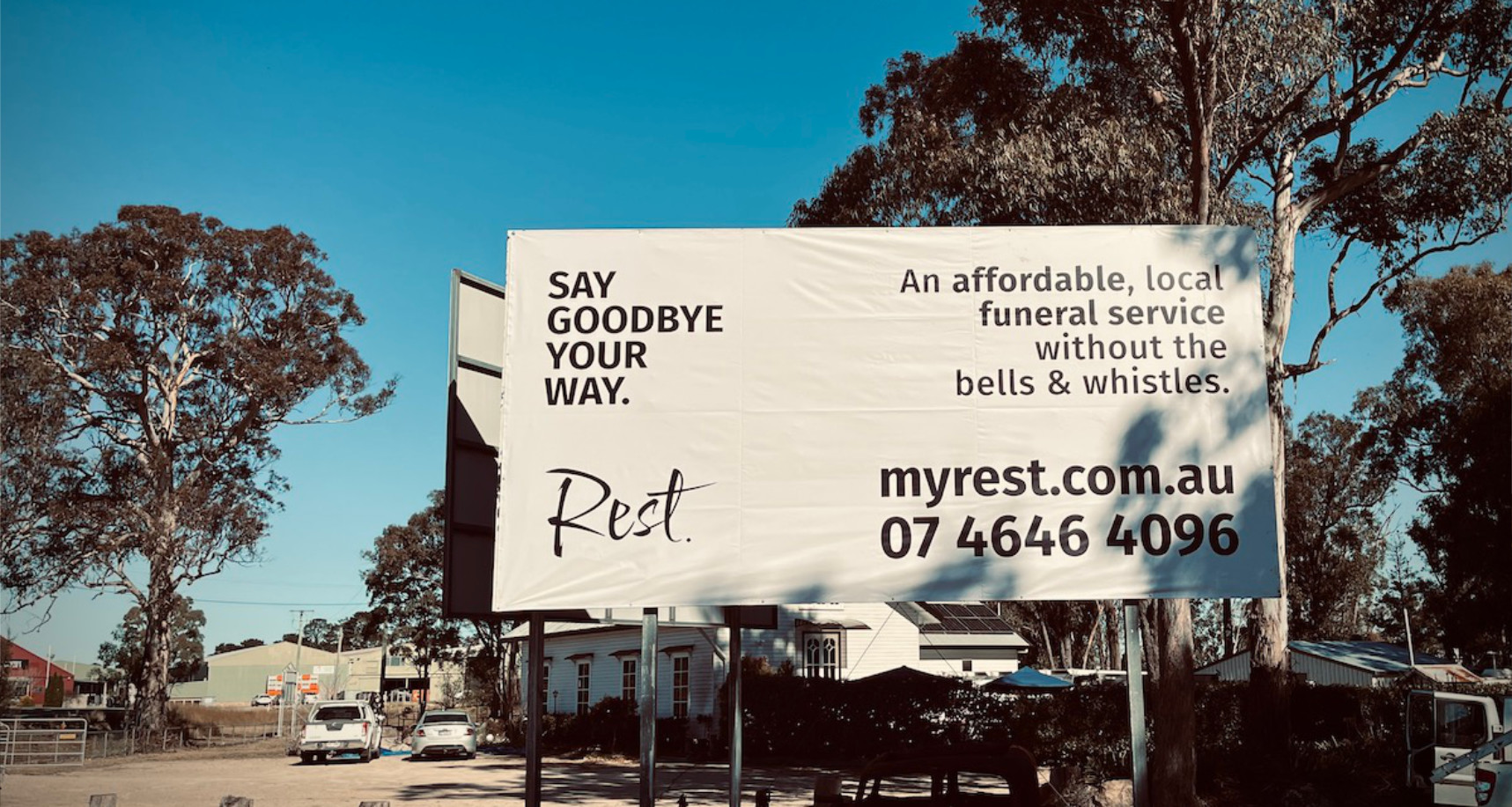
Serving families throughout Guyra and the surrounding region.
Why choose Rest?
Choosing a funeral service provider is a personal decision. We believe families in Guyra should have access to an independent alternative. An alternative that doesn't rely on selling the biggest funeral package possible.
At Rest, we aim to:
- give you clear information before you make decisions
- explain the alternatives, including simple and low-cost options
- provide transparent pricing
- respect the choices you make
- encourage families to participate in the farewell
- avoid unnecessary extras
- work with you rather than dictate how things should be done
Most importantly, we don't believe there is a "standard" way to say goodbye. Your person was unique. Their farewell can be too.
What does a funeral in Guyra cost?
There isn't one answer because there isn't one type of funeral. The cost depends on what you choose, cremation or burial. It will also vary depending onwhether you have a funeral service, the type of casket or coffin, transport, cemetery charges and other arrangements.
At Rest, we separate our professional fees from costs that are paid to third parties wherever practical, so you can see what you're actually paying for.
We also believe you should be able to make decisions based on clear prices rather than being presented with an expensive package and being told that everything is necessary.
View our funeral pricesFuneral services for Guyra and surrounding communities
While Guyra is one of our service areas, we also care for families across New England and surrounding districts.
If you're unsure whether we can help where you live, just ask.
What happens when someone dies at home?
If someone dies at home, what happens next depends on the circumstances of the death.
If the death was expected, there are established steps for confirming the death and arranging for the person to be cared for and transferred when the family is ready.
If the death was unexpected or the cause is unknown, the process can be different and may involve the police or the Coroner.
You don’t need to work all of this out yourself. We can help you understand what needs to happen and what your choices are.
For a more detailed explanation, see What happens when someone dies in Queensland.
If you’re wondering whether your loved one can remain at home for a while, see Can my loved one stay at home.
Related
Can I have a cremation without service?
Yes. You can choose cremation without having a funeral service.
This is often called a direct cremation. We collect the person who has died, take care of the necessary arrangements and cremation, and return the cremated remains to you afterwards.
There is no ceremony at the crematorium and no need for a traditional funeral service.
Some families choose this because they want something simple and private. Others choose to hold a memorial or celebration of life later, when everyone has had time to gather.
There is no right or wrong way to say goodbye. What matters is choosing what feels right for you and your family.
Related
Can I have a memorial after cremation?
Yes. A memorial can be held after a cremation.
There is no requirement for the ceremony to happen before the cremation. Some families choose a simple cremation first, then hold a memorial service or celebration of life later.
This can give everyone a little more time to gather, particularly when family and friends are travelling from different places.
A memorial can be held wherever it feels right — at a community hall, a place that was special to the person, at home, or another meaningful location.
There is no set formula. It can be as formal or as relaxed as you like, and you can take the time to create something that genuinely reflects the person you are remembering.
Related
- Cremation without service
- Funeral Pricing
What are funeral options for burial?
A burial funeral can be as simple or as formal as you want. There is no single way a burial has to happen.
You might choose a graveside funeral, with everyone gathering at the cemetery for the burial and ceremony.
You might have a funeral service at a church, chapel or other place of worship, followed by the burial at the cemetery.
You could hold the service at a private venue, community hall, family property or another place that means something to you, and then travel to the cemetery for the burial.
You can also have the burial first and hold a memorial or celebration of life afterwards, if that suits your family better.
The ceremony itself can be whatever you want it to be. A celebrant, minister, family member or friend can lead it, or you can keep things very simple without a formal celebrant.
The important thing is that the burial does not have to follow a traditional funeral format. You can choose where you gather, who leads the ceremony, who takes part and how much or how little ceremony you want.
If you are not sure what is possible, talk to us. We can help you work through the options and put together something that feels right for you.
Related
Do I need to use a funeral director?
No. Queensland law does not require you to use a funeral director for every part of a funeral.
A family can take an active role in arranging a funeral, and the law provides for a close relative or personal representative to make applications such as an application for permission to cremate, either personally or through an agent.
The practical difficulty is that some facilities and service providers have their own processes and may only accept arrangements through an authorised funeral service provider. That is one of the reasons Rest exists: to help families understand what they can do themselves while stepping in where professional assistance is actually needed.
You do not have to choose between doing everything yourself and handing everything over. There is a lot of ground in between.
Related
- What does Rest do
- What doesn’t Rest do
- What happens when someone dies in Queensland
Undertaker? Funeral Director?
Undertaker, funeral director and funeral service provider can all describe the person or business helping to organise a funeral. The words have different histories, but today there is no single title that tells you exactly what someone does.
Where did “undertaker” come from?
The word undertaker originally meant simply someone who undertook a task or responsibility. The specialised use of the word for someone who managed funerals and arrangements for burial dates back to the late 17th century.
The name makes quite a lot of sense when you think about it. An undertaker was someone who undertook the responsibility of the funeral, like;
arranging the coffin, transporting the deceased, organising the burial and bringing together the various people and services needed.
Historically, undertakers often came from trades such as cabinet making, stonemasonry, printing and upholstery. In Queensland, the State Library describes undertaking as a business that brought together many different trades and skills.
So where did “funeral director” come from?
As funerals became more organised and the role expanded, funeral director became increasingly used to describe someone who directed and managed the various parts of a funeral.
There isn’t a single clear date when “funeral director” replaced “undertaker”. The change happened gradually, particularly around the late 19th and early 20th centuries, as the funeral industry became more formalised. The British Undertakers’ Association, for example, was established in 1905 and later became the National Association of Funeral Directors.
The important thing is that the change in title did not necessarily mean a completely different job. A funeral director was still, in many respects, undertaking the responsibility for arranging and managing a funeral.
What about “funeral service provider”?
Funeral service provider is a more descriptive and less traditional term. It recognises that there are many different ways a person or business might help a family after someone dies.
A funeral service provider might collect and care for the deceased, arrange a burial or cremation, help with paperwork, coordinate a funeral or memorial, or simply provide some of those services.
It also avoids suggesting that every funeral has to be directed in the traditional sense.
What do we call ourselves?
We use undertaker and funeral service provider because both describe what we actually do.
We undertake the practical responsibility of bringing everything together, while recognising that the funeral itself belongs to the family. We can organise as much or as little as you need, rather than assuming there is one traditional funeral that everyone should have.
The funeral should belong to you, not the funeral industry.