
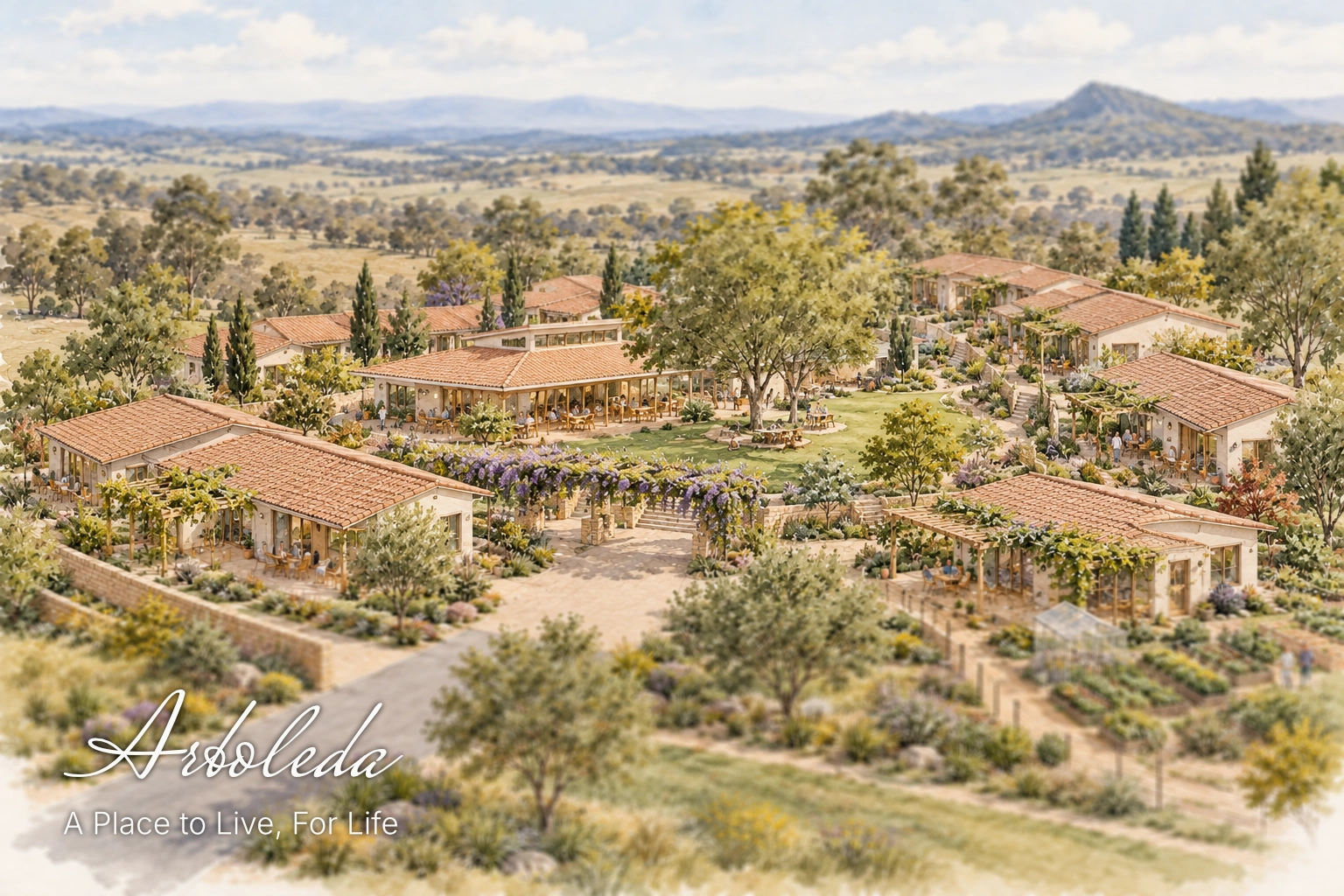
A Place to Live, For Life
Please note: Arboleda is a conceptual idea, not an existing place or established development. While it draws inspiration from intergenerational living concepts around the world, it represents an original vision that is still being explored and developed.
Most of us carry around the same picture of getting old. You stay in the family home as long as you can, then something happens (a fall, a diagnosis, a long night on your own) and you move. A retirement village if you’re lucky, aged care if you’re not, and somewhere near the end, a hospital bed.
In my work with Rest I see where that picture finishes, and I keep coming back to one question. Why do we accept that the last chapter has to happen somewhere that isn’t home?
So I’ve been sketching out something different. It’s not about building a better place to grow old. It’s about building a better place to live, and letting life take its natural course.
What it is (and what it isn’t)
Picture a small, resident-owned community on the Southern Downs. Everyone has their own home with their own front door. In the middle sits a shared kitchen, dining room and gardens, so it’s easy to cook, eat and spend time together, if and when you feel like it. Younger people live there too, as neighbours. And older residents never have to leave because they get older or need more care.
It’s worth being clear about what it isn’t, because those differences decide how the place is regulated, financed and built.
- It isn’t aged care. Nobody is ‘admitted’. Care comes in from outside, the same as it would at any house in town.
- It isn’t a retirement village. There’s no age test and no service package sold with your home.
- It isn’t a commune. Private homes, private money, shared life by choice.
Who lives there
Owners buy in and hold a home for life. Most will probably be older, but there’s no age requirement. A younger family who shares the idea makes the mix stronger (and makes resale easier down the track).
Younger neighbours are young nurses, allied health workers, students and the like, renting smaller homes at a real discount in return for being part of the community. What’s asked of them is light and social: join the shared dinner a couple of nights a week, take a slot on the cooking or garden roster, come to the monthly meeting, and be the friendly face who knocks on a door if a light’s been off all day.
The line that matters is this: they are neighbours, not carers. Nobody expects them to give personal care. If a nurse neighbour wants to do paid care work for a resident, that goes through a care provider, on a timesheet, separate from where they live.
This isn’t a new idea, by the way. The Humanitas home in Deventer, in the Netherlands, has had students living rent-free among older residents for over a decade, in return for a few hours a month of simply being good neighbours.
A community host rounds it out. One home is set aside for a paid, part-time host who keeps shared life ticking over: rosters, the kitchen, welcoming new people, being the one contact for visiting care providers, and noticing when someone’s struggling. They coordinate. They don’t deliver care.
Getting the balance right
How many younger neighbours is the right number? Three things pull against each other. The more neighbours there are, the more likely someone able-bodied is home at any hour, and that’s what lets an older person feel safe living on their own. Too few, though, and each one ends up surrounded by frail neighbours and slides into being an unpaid carer (and then they leave). On top of that, every discounted home is capital the owners have to carry.
I ran the numbers, and the sweet spot looks like about 2.5 older residents to every younger neighbour. For a first build that’s 8 owner homes (roughly 13 people), 5 neighbour homes and 1 host home. With 5 neighbours there’s around a 97% chance at least one is home during the day and close to 100% at night, and each neighbour lives alongside fewer than one frail older resident on average. That feels like being a good neighbour, not a carer. Past 5, the gains flatten right out.
The cost of carrying those neighbour homes works out at about $137,500 per owner, or closer to $96,000 if rent covers around 30% of it. These are planning estimates, so a lawyer, accountant and quantity surveyor will have their say.
Care comes to you
Nobody is employed to care for residents. Care arrives the way it would at any house in town: a home care provider, your GP, community nurses and, at the end, a palliative care team. What the community adds is that the care lands somewhere people notice, help out and keep you company.
Each resident holds their own government funding. Support at Home replaced Home Care Packages in November 2025, with yearly budgets running from about $11,000 to about $80,000 (CareAbout). If most residents choose the same provider, that provider can base a small team on site for part of each day. Less travel, fewer strangers, the same faces each week.
I’ll be honest about the limits, though. Even the top classification funds roughly 20 hours of care a week. Someone who needs a person with them around the clock needs more than that. So every owner home has a care-ready room, with its own door and ensuite, for a live-in carer, a family member or a paid night carer when the time comes. Each owner also makes a written plan early on: what they’d want, who pays for extra care, and the few situations where staying wouldn’t be safe. Most of the time the answer will be to bring more help in, not to move out.
Dying where you lived
This is the part most places avoid, and it’s the part closest to my heart. Here it gets planned for openly, from the very first information evening.
- Advance care planning when you join, updated every year and shared with your GP.
- A relationship with the local palliative care service and GPs who’ll do home visits, set up before anyone needs it. Support at Home also has an End-of-Life Pathway, currently $25,000 over 12 weeks for people with about three months or less to live.
- Bedrooms that fit a hospital bed with room for family around it, can be kept cool, and have a clear, wide route out for a trolley or coffin.
- Time after death. Families can keep their person at home for a vigil, the community can gather to say goodbye, and a guest suite gives visiting family somewhere to stay.
- A quiet corner of the garden for farewells and remembering.
You have time. That’s as true here as anywhere, maybe more so.
Who owns it
The plan is company title. A company owns the land and every building. Owners buy shares that give them the right to live in a particular home for life, and the company keeps the neighbour and host homes and rents them out. A board elected by the shareholders runs things, under a constitution that covers who can join, levies, care planning and what happens when an owner dies (a surviving partner’s rights, first refusal for the company, and a buyback fund so estates aren’t left stuck).
Now, the elephant in the room. In Queensland, a place where older people pay to buy in and receive services can count as a retirement village under the Retirement Villages Act 1999, with all the registration and exit rules that come with it. This model is built to sit outside that (no age test, no service package, shared meals run by residents out of a food kitty), but that’s a question for a Queensland property lawyer, not something I get to decide by design. So that legal opinion comes first, before anyone signs up.
The homes
Every home should read as a house, never a unit in a facility: its own front door and porch facing the shared garden, and a private courtyard facing away from it, so it’s as easy to keep to yourself as it is to join in. The neighbour homes sit in their own little cluster on one side, so late nights and early shift starts don’t wake anyone.
Inside, they’re built for the whole of life without looking clinical. Step-free throughout, wide doors, hobless showers with room for a helper, and walls ready for grab rails. Shared solar and a site battery keep fridges, medical equipment and the shared kitchen going through outages.
The site I have in mind is around a hectare on a town edge, within 10 minutes of a GP, pharmacy and hospital. Warwick or Stanthorpe would suit, and being near the hospital helps with finding nurse neighbours.
As for cost, the early placeholder for the whole build is somewhere between $4.6 and $6.2 million. That’s a rough number for a quantity surveyor to replace, and it’s one of the things I want to test with interested households.
Where it’s at
Right now it’s a plan on paper. The next steps are a legal opinion on the structure, then an information evening to find 10 to 12 households who are genuinely keen, then conversations with the local hospital, nursing schools, palliative care, GPs and home care providers, and finally sites, council and an architect who knows co-housing.
If this sounds like a place you’d want to live (or you know someone who would), shoot me a message. I’d love to hear what you think, especially the bits you’d do differently.