Can't find the answer you're looking for?
Frequently Asked Questions
Ask us. We're here to help you understand what's ahead.
Burial
What are funeral options for burial?
A burial funeral can be as simple or as formal as you want. There is no single way a burial has to happen.
You might choose a graveside funeral, with everyone gathering at the cemetery for the burial and ceremony.
You might have a funeral service at a church, chapel or other place of worship, followed by the burial at the cemetery.
You could hold the service at a private venue, community hall, family property or another place that means something to you, and then travel to the cemetery for the burial.
You can also have the burial first and hold a memorial or celebration of life afterwards, if that suits your family better.
The ceremony itself can be whatever you want it to be. A celebrant, minister, family member or friend can lead it, or you can keep things very simple without a formal celebrant.
The important thing is that the burial does not have to follow a traditional funeral format. You can choose where you gather, who leads the ceremony, who takes part and how much or how little ceremony you want.
If you are not sure what is possible, talk to us. We can help you work through the options and put together something that feels right for you.
Related
Do you provide burial funerals in my area?
Yes. We can assist with burial funerals in {{town}} and coordinate arrangements with the relevant cemetery.
A burial can be arranged as a traditional funeral service, a simple graveside farewell or something more personal to your family.
We can explain the options and help coordinate the arrangements with the cemetery.
Related
Pre planning
Can I prepay my funeral?
Yes. You can prepay a funeral, and a funeral bond can be a useful way to put money aside for it.
A prepaid funeral can take some of the financial and decision-making pressure away from your family later. With a funeral bond, money is set aside specifically for your funeral rather than relying on an insurance policy with ongoing premiums.
If you choose to prepay with Rest, we can talk through what you want your funeral to look like, what you want to pay for now, and what can be left for your family to decide later.
A prepaid funeral is different from simply writing down your wishes. If you are not ready to pay for your funeral, you can still preplan it with us so your family has a clear record of what you want.
Learn more about pre-paid funeral options.
Related
Can I preplan my funeral?
Yes. You can plan your funeral with Rest before you need it.
You do not have to pay for a funeral to make your wishes known. Preplanning can simply mean talking through the choices, recording what matters to you and making sure your family knows where to find that information.
If you do want to put money aside as well, we can talk to you about a funeral bond and the options currently available through Rest.
The important part is that you get to make the decisions while you can, rather than leaving your family to guess later.
Get in touch with Rest to start planning.
Related
My funeral wishes are in my will. Do I need to plan?
Yes. If your funeral wishes are important to you, it is worth making them known separately from your will.
We hear this quite often:
“My will says I want to be cremated.”
Putting your wishes in your will is certainly better than not recording them at all. The problem is that a will is primarily concerned with what happens to your estate after you die, while your funeral arrangements need to be dealt with much sooner.
The timing matters
When someone dies, their funeral usually needs to be arranged within days.
The will, however, forms part of the process of dealing with the person’s estate. It may not be located, read or formally dealt with until after the immediate arrangements have already been made.
By that point, the burial or cremation may have already taken place.
This means that a funeral wish written in your will can be perfectly clear and still arrive too late to be useful.
Tell your family as well
Your will shouldn’t be the only place where your funeral wishes are recorded.
If you want to be cremated, buried, have a particular type of funeral, or have no funeral at all, tell the people who are likely to be involved when you die.
It can be as simple as having a conversation and writing down what you want.
You might want to record things such as:
- Whether you want to be buried or cremated
- Where you would like your farewell to take place
- Whether you want a funeral or memorial service
- Whether you have a particular coffin or casket in mind
- What you would like to happen with your ashes
- Any particular wishes you have about music, flowers or who should be involved
You don’t have to decide every detail.
A will and funeral plan do different jobs
Think of your will as instructions about your estate and a funeral plan as instructions about your farewell.
They can work together, but one shouldn’t replace the other.
When I recently made my own will, I discussed this with my solicitor. We agreed that funeral planning should be kept separate because the people arranging your funeral need access to those wishes when they are making the immediate arrangements, not later as part of administering your estate.
You don’t have to pre-pay
Planning your funeral doesn’t necessarily mean paying for it in advance.
You can simply record your wishes and make sure the people who will need to know about them can find them.
If you do want to remove the financial burden from your family as well, you can consider pre-paying your funeral, including through a funeral bond.
The important thing is that your wishes are known when they are needed.
So, should I put my funeral wishes in my will?
Yes, if you have funeral wishes, there is no harm in recording them in your will.
But don’t stop there.
A will is important.
But when it comes to your funeral, don’t make your family wait for your will to tell them what you wanted.
Death
Can my loved one stay at home?
Yes. In many circumstances, your loved one can remain at home after death.
Rest supports families who want to spend more time with their person before burial or cremation. That might mean keeping someone at home for a while, sitting with them, inviting family and friends in, or taking part in washing and dressing them.
Where cooling is needed, equipment such as a cooling plate can help keep the person at an appropriate temperature while family have that time together. If the death is being investigated by the coroner, there are additional steps and permissions involved, but that does not necessarily mean a family cannot later bring their loved one home.
There is no single right way to say goodbye. For some families, having time at home is an important part of their goodbye.
Rest can help you understand what is possible in your circumstances and what needs to happen next.
Related
What happens when someone dies at home?
If someone dies at home, what happens next depends on the circumstances of the death.
If the death was expected, there are established steps for confirming the death and arranging for the person to be cared for and transferred when the family is ready.
If the death was unexpected or the cause is unknown, the process can be different and may involve the police or the Coroner.
You don’t need to work all of this out yourself. We can help you understand what needs to happen and what your choices are.
For a more detailed explanation, see What happens when someone dies in Queensland.
If you’re wondering whether your loved one can remain at home for a while, see Can my loved one stay at home.
Related
What happens if someone dies at home in my area?
What happens next depends on the circumstances of the death.
If the death was expected, there are usually established processes involving the person’s doctor or another appropriate health professional.
If the death was unexpected, the circumstances may require involvement from the Queensland Coroner.
We can guide you through the process and explain what needs to happen next.
Related
- What happens when someone dies
Daisybox
Can we get the Daisybox early?
Yes. We can arrange for a Daisybox to be delivered before the funeral so you have time to decorate it.
In fact, we encourage it when a family wants to make the coffin part of the farewell.
A Daisybox can be decorated by family and friends with drawings, photographs, messages, paint, flowers or anything else that feels right. Having it at home beforehand can give everyone time to take part without the pressure of doing everything immediately before the funeral.
What is a Daisybox explains more about the coffin itself, and our Daisybox Decorations gallery shows some of the ways families have made them their own.
Related
- What is a Daisybox
- Daisybox Decorations
What is a Daisybox?
A Daisybox is a cardboard coffin designed to give families a simple, affordable and highly personal alternative to a conventional coffin or casket.
It can be decorated by family and friends with drawings, photographs, messages, paint, flowers or whatever else feels meaningful. For some families, that process becomes part of the funeral itself — something they can do together rather than something done for them.
A Daisybox is also designed to be suitable for cremation when used in accordance with the crematorium’s requirements.
You can also see examples in Daisybox Decorations.
Related
- Can we get the Daisybox early
- Daisybox Decorations
- What coffins or casket can be cremated
- Daisybox (Natural)
Cremation
Can I have a cremation without service?
Yes. You can choose cremation without having a funeral service.
This is often called a direct cremation. We collect the person who has died, take care of the necessary arrangements and cremation, and return the cremated remains to you afterwards.
There is no ceremony at the crematorium and no need for a traditional funeral service.
Some families choose this because they want something simple and private. Others choose to hold a memorial or celebration of life later, when everyone has had time to gather.
There is no right or wrong way to say goodbye. What matters is choosing what feels right for you and your family.
Related
- Funeral Pricing
- Cremation
How do I open a standard ashes container?
The standard ashes container can be opened with a flat-head screwdriver.
Gently work the screwdriver around the lid rather than forcing it in one place. Take care not to damage the container or spill the cremated remains.
If you would rather not open the container yourself, contact us and we can help.
The standard container is described in Standard Ashes Container.
Related
Can I arrange a cremation without a funeral service?
Yes. A cremation does not require a traditional funeral service.
Our bare cremation option is designed specifically for families who want a simple cremation without a formal ceremony.
You can choose to hold a farewell before or after the cremation, or you may decide that no formal service is right for you.
Related
What body coverings can be cremated?
For cremation, natural materials are generally preferred for clothing or a shroud.
Silk, wool, cotton and leather are commonly suitable. Polyester clothing may also be acceptable, depending on the crematorium and the particular item.
Some materials are not suitable for cremation, including:
- materials containing PVC or poly-vinyl acetate
- latex-based rubber or plastic, such as wetsuit material
- rubber or plastic soles and uppers on shoes, sandals or slippers
If you are unsure about a particular item of clothing, tell us what it is before the cremation. We can check the requirements of the crematorium being used.
Related
What coffins or casket can be cremated?
Coffins, caskets and non-enclosed transfer trays used for cremation need to meet the requirements of the crematorium.
For the crematoriums Rest commonly works with, acceptable construction generally includes cardboard, timber or manufactured wood products. There are also restrictions on materials and fittings, including:
- no PVC
- no metal linings or inserts
- no innerspring, latex-rubber or PVC mattresses or pillows
- only suitable ferrous metal screws or nails
If you are considering a particular coffin, casket or homemade option, talk to us first. The safest approach is to check it against the requirements of the crematorium before it is built or purchased.
Related
What happens during a cremation?
During cremation, the body and the coffin or casket are placed into a cremator and exposed to very high temperatures. The organic material is reduced, while the remaining bone fragments are cooled and processed into the cremated remains commonly called ashes.
The ashes are therefore not simply the remains of clothing or the coffin. They are predominantly processed bone.
After cremation, the remaining bone fragments are allowed to cool and are then processed to produce the familiar granular or powder-like cremated remains, which are placed into the ashes container.
There are some materials and medical devices that can affect whether a cremation can proceed and how the remains are handled. What happens to implants when you are cremated explains more about this.
Related
What happens to implants when you are cremated?
Some medical implants and devices can create a risk during cremation and need to be identified before the cremation takes place.
If your loved one has a pacemaker, implanted defibrillator, drug infusion pump or another device that may present a cremation risk, tell us as early as possible. The relevant doctor or crematorium will determine what needs to happen before cremation.
Queensland law requires permission for a cremation. Where a doctor is responsible for that permission, the doctor examines the circumstances and considers whether there is a cremation risk.
Some prosthetic limbs and other implants do not necessarily prevent cremation, but it is still important that we know about them so the crematorium can make the appropriate arrangements.
If you are unsure what has been implanted, tell us what you do know. We can help work out what information is needed.
Related
What will the ashes be returned in?
Unless you choose something different, Rest returns cremated remains in a standard ashes container.
It is a simple container intended to safely hold the cremated remains. You can choose a different urn or container if you would prefer something more personal or permanent.
If you want to transfer the ashes into another container yourself, How do I open a standard ashes container explains how the standard container is opened.
!ashes-container.png
Related
Where does a cremation take place?
The cremation takes place at a licensed crematorium.
Depending on the location and scheduling, Rest currently works with crematorium partners including Warrill Park Lawn Cemetery & Crematorium and Eco Memorial Park.
The location used for a particular cremation depends on practical factors such as where the person is being cared for, transport and availability.
If you want to know where a particular cremation will take place, ask us. We can tell you which crematorium is being used for that arrangement.
Related
Funerals
Do I need to have a funeral?
No. There is no legal requirement to have a funeral service or an official funeral gathering when someone dies.
A funeral can be a meaningful way for family and friends to come together, say goodbye and remember the person who has died. For many people, that gathering is an important part of grieving.
But it is a choice.
There is no requirement for everyone to gather at a church, chapel, cemetery or other venue. You can choose to have a simple burial or cremation without a ceremony, or you can arrange something later when the time feels right.
You might have a graveside gathering, a church or chapel service, a service at a private venue, a gathering at home, or something completely different. You can also have a memorial or celebration of life after the burial or cremation.
Some families want a funeral straight away. Others don’t want a formal funeral at all. Some want to say goodbye privately and gather together later.
There is no right or wrong way to do it. What matters is that you have the opportunity to make a choice rather than feeling that a traditional funeral is something you are required to have.
If you do want a funeral, we can help you make it as simple, personal or traditional as you like. And if you don’t, we can help with that too.
Related
How do I find out if someone has a funeral?
There is no single public register of every funeral in the area.
Families decide for themselves whether to publish funeral details, so a funeral may not be publicly advertised at all.
For local notices, many people use the Warwick and District Funeral Notices Facebook group. It is free for members to use and can be a useful place to look for local funeral information.
Rest only publishes a funeral notice when the family asks us to. When they do, we can create a tribute page where friends and family can leave a private message of condolence for the family.
We believe the decision about how much information to share belongs to the family.
Related
Who provides funeral services in my area?
Rest Funerals & Death Care provides independent funeral and death care services in {{town}} and throughout the surrounding region.
We help families arrange funerals, cremations, burials and other forms of farewell, with an emphasis on clear information, genuine choice and the freedom to say goodbye your way.
We don’t believe there is a standard way to arrange a funeral. Our role is to explain your options, take care of the things that need to be taken care of, and help you create a farewell that works for your family.
Related
Process
Undertaker? Funeral Director?
Undertaker, funeral director and funeral service provider can all describe the person or business helping to organise a funeral. The words have different histories, but today there is no single title that tells you exactly what someone does.
Where did “undertaker” come from?
The word undertaker originally meant simply someone who undertook a task or responsibility. The specialised use of the word for someone who managed funerals and arrangements for burial dates back to the late 17th century.
The name makes quite a lot of sense when you think about it. An undertaker was someone who undertook the responsibility of the funeral, like;
arranging the coffin, transporting the deceased, organising the burial and bringing together the various people and services needed.
Historically, undertakers often came from trades such as cabinet making, stonemasonry, printing and upholstery. In Queensland, the State Library describes undertaking as a business that brought together many different trades and skills.
So where did “funeral director” come from?
As funerals became more organised and the role expanded, funeral director became increasingly used to describe someone who directed and managed the various parts of a funeral.
There isn’t a single clear date when “funeral director” replaced “undertaker”. The change happened gradually, particularly around the late 19th and early 20th centuries, as the funeral industry became more formalised. The British Undertakers’ Association, for example, was established in 1905 and later became the National Association of Funeral Directors.
The important thing is that the change in title did not necessarily mean a completely different job. A funeral director was still, in many respects, undertaking the responsibility for arranging and managing a funeral.
What about “funeral service provider”?
Funeral service provider is a more descriptive and less traditional term. It recognises that there are many different ways a person or business might help a family after someone dies.
A funeral service provider might collect and care for the deceased, arrange a burial or cremation, help with paperwork, coordinate a funeral or memorial, or simply provide some of those services.
It also avoids suggesting that every funeral has to be directed in the traditional sense.
What do we call ourselves?
We use undertaker and funeral service provider because both describe what we actually do.
We undertake the practical responsibility of bringing everything together, while recognising that the funeral itself belongs to the family. We can organise as much or as little as you need, rather than assuming there is one traditional funeral that everyone should have.
Do I need to use a funeral director?
No. Queensland law does not require you to use a funeral director for every part of a funeral.
A family can take an active role in arranging a funeral, and the law provides for a close relative or personal representative to make applications such as an application for permission to cremate, either personally or through an agent.
The practical difficulty is that some facilities and service providers have their own processes and may only accept arrangements through an authorised funeral service provider. That is one of the reasons Rest exists: to help families understand what they can do themselves while stepping in where professional assistance is actually needed.
You do not have to choose between doing everything yourself and handing everything over. There is a lot of ground in between.
Related
What happens when someone dies in Queensland
What happens after someone dies in Queensland depends on where and how the death occurred, but there are a few important steps that need to happen before burial or cremation.
The first priority is establishing the death and determining whether the death needs to be referred to the coroner. After that, the family can begin making decisions about care of the person, burial or cremation, and the kind of farewell they want.
If the person is to be cremated, Queensland requires permission to cremate. A close relative or personal representative can apply, either themselves or through an agent such as a funeral director.
The death also needs to be registered with the Queensland Registry of Births, Deaths and Marriages. It must generally be registered within 14 days.
There is much more to the process than can sensibly fit in an FAQ. We have written a detailed guide covering the journey from the moment of death through to the death certificate:
Read the funeral process in Queensland.
Related
- no standard funeral director
- Can my loved one stay at home
- When will I receive a Death Certificate
- Application for Permission to Cremate (Form 1)
What is a will?
A will is a legal document that says what you would like to happen to the things you leave behind when you die.
When people hear the word “will”, they often think about money, houses, bank accounts and other property.
Those things are certainly part of it, but a will can be about much more than what happens to your stuff.
It’s not just about money
A will can give you an opportunity to make your wishes known about the people and things that matter to you.
If you have children who are under 18, for example, one of the most important questions to think about is:
Who would look after my children if I wasn’t here?
You can use your will to nominate someone you would like to act as a guardian for your children.
This doesn’t mean that the person you name automatically becomes the legal guardian in every circumstance. Decisions about children are ultimately made according to their best interests. But making your wishes known can be an important part of planning for their future.
You might also want to think about:
- Who you would trust to care for your children
- How you would like your children to be supported
- Who you would trust to manage money or property left to them
- What should happen to your home and other possessions
- Whether there are particular belongings you want specific people to receive
- Who you would like to manage your estate
You don’t have to be old to need a will
One of the biggest misconceptions about wills is that they are something you worry about when you get old.
You don’t need to be old to have things worth protecting.
You might have young children. You might own a home. You might have superannuation, savings, a car, a business, personal possessions or simply people you care deeply about.
Even if you don’t have much money or property, there can still be good reasons to make a will.
If you have children, the question of who you would want to care for them is reason enough to start thinking about it.
What happens if I don’t have a will?
If you die without a valid will, you are said to have died intestate.
Your estate is then distributed according to the intestacy laws that apply to you, rather than according to instructions you have made yourself.
That doesn’t necessarily mean your wishes will be ignored, but it does mean that you haven’t left your own instructions for how your estate should be dealt with.
A will is not a funeral plan
This is something we see quite often.
People tell us:
“It’s all in my will. I want to be cremated.”
A will and a funeral plan serve different purposes.
Your will deals primarily with your estate after you die. Your funeral arrangements need to be known by the people arranging your funeral, often within days of your death.
If you have particular wishes about your funeral, don’t rely on your will being the only place they are recorded.
Tell the people who will need to know.
You can read more about this in My funeral wishes are in my will. Do I need to plan?.
Where do I start?
Making a will doesn’t have to mean making complicated decisions about everything you own.
Start by thinking about the people who matter to you and what you would want for them if you weren’t around.
Then consider your property, finances and possessions, and who you trust to carry out your wishes.
A solicitor can help you understand your options and prepare a will that reflects your circumstances.
And remember: a will isn’t something you make once and forget about forever. As your family, relationships, finances and circumstances change, it is worth reviewing it to make sure it still reflects what you want.
The important thing
A will is about more than who gets your money.
It is about leaving clear instructions for the people you leave behind.
You don’t need to be old, wealthy or own a house to start thinking about what you would want to happen if you died.
Sometimes the most important question isn’t “Who gets my stuff?”
It’s “Who will look after the people I love?”
What is probate?
Probate is a court process that gives an executor formal authority to administer a deceased person’s estate when a grant of probate is required.
In Queensland, a grant of probate is issued by the Supreme Court of Queensland when there is a valid Will and the executor named in it is applying for authority to administer the estate.
Probate is not automatically required for every estate. Whether a grant is needed can depend on the assets involved and the requirements of organisations such as banks or other institutions.
Probate is separate from the funeral process itself. If you need to deal with an estate, the Queensland Courts provide current information about probate and other grants of administration. For legal advice about a particular estate, speak with a qualified legal practitioner.
Related
When will I receive a Death Certificate?
The timing of a Queensland death certificate depends on when the death registration is submitted and whether the Registry of Births, Deaths and Marriages has everything it needs.
Rest can help with the death registration process when we are acting as the funeral service provider. If you are not using a funeral director, the Queensland Government allows you to register the death yourself.
The Queensland Registry currently says that standard applications are processed in up to 10 business days once an application with all required documents has been received. Applications with missing information or documents can take longer, and postage time is additional.
The death itself generally needs to be registered within 14 days.
This is different from the time it takes us to complete the information and paperwork needed for registration. If you are waiting for a certificate, we will let you know if there is something we need from you.
Queensland Government: Register a death.
Related
Pricing
How much does a funeral cost in my area?
There is no single cost for a funeral.
The cost depends on the type of farewell you choose and the arrangements involved. A simple cremation can cost considerably less than a traditional funeral involving a service, casket and burial.
At Rest, we believe you should be able to understand what you’re paying for before making decisions. Our current pricing is available online, so you can see the costs for our services and make choices that are right for you.
Related
- Funeral Pricing
What is the cheapest funeral?
For most families, a direct cremation is the simplest and usually the lowest-cost funeral option.
You may also hear it called:
- bare cremation
- simple cremation
- unattended cremation
- no-service cremation
A direct cremation generally means the person is cremated without a traditional funeral service taking place beforehand. It does not mean the funeral has to be impersonal or that the family cannot hold a farewell later.
One of the reasons Rest offers simple funerals is that families should be able to spend money on the parts of a farewell that actually matter to them, rather than paying for things they do not want.
Related
Memorials
Can I have a memorial after cremation?
Yes. A memorial can be held after a cremation.
There is no requirement for the ceremony to happen before the cremation. Some families choose a simple cremation first, then hold a memorial service or celebration of life later.
This can give everyone a little more time to gather, particularly when family and friends are travelling from different places.
A memorial can be held wherever it feels right — at a community hall, a place that was special to the person, at home, or another meaningful location.
There is no set formula. It can be as formal or as relaxed as you like, and you can take the time to create something that genuinely reflects the person you are remembering.
Related
- Cremation without service
- Funeral Pricing
Can we have a memorial service after cremation?
Yes. A memorial service can take place after the cremation.
It can be held days or weeks later, giving family and friends more time to organise a meaningful gathering without having to arrange everything immediately after the death.
A memorial can be as simple or elaborate as you choose and can be a personal way to remember someone after their cremation.
Related
- Memorial Services
About Rest
What areas does Rest service?
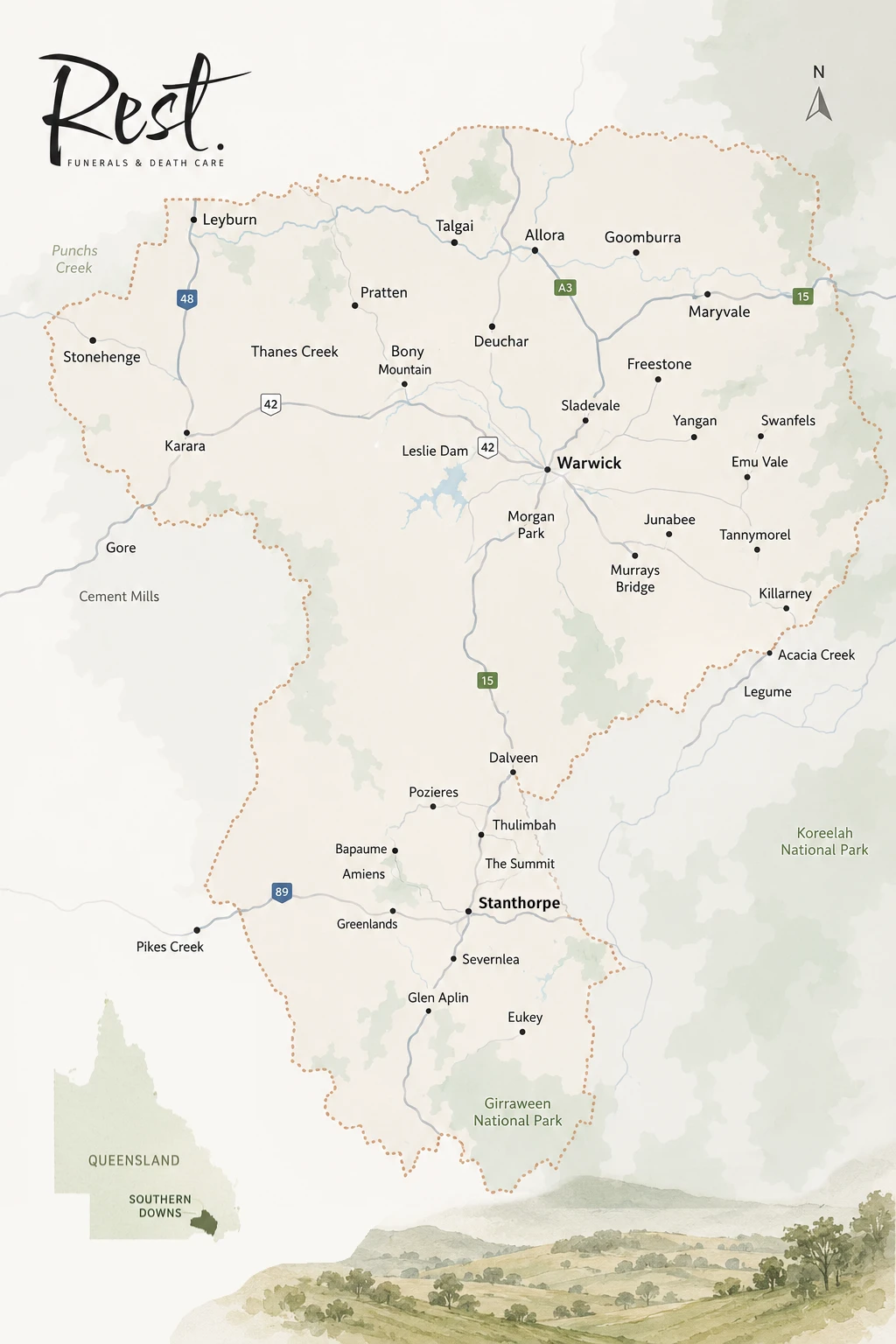
Rest mainly provides services for families across the Southern Downs, Goondiwindi and Tenterfield areas. We can also work in Scenic Rim, Ipswich and Brisbane
Because we are a regional funeral service, the exact practical arrangements can vary depending on where someone has died, where they are to be cared for and where the burial or cremation will take place.
If you are unsure whether we can help, ask us. It is much easier to have the conversation than to assume you are outside our area.
Our service area includes communities throughout the Southern Downs Regional Council, Goondiwindi Regional Council and Tenterfield Shire Council areas.
Related
What does Rest do?
Rest helps families have a simpler, more affordable and more personal funeral.
We are here for people who want more choice and more involvement in what happens after someone dies. That can include:
- choosing a more affordable funeral
- exploring whether someone can die or remain at home
- spending more time with a person after death
- taking part in washing and dressing, with support where appropriate
- understanding what the family can do themselves
- taking a more active role in the funeral and farewell
Our job is not to make every funeral look the same. It is to explain what is possible, what is required, what things cost and where we can help — then let the family decide what is right for them.
Related
- What does Rest not do
- no standard funeral director
- Can my loved one stay at home
What does Rest not do?
Rest does not offer every traditional funeral service, and that is deliberate.
We encourage families to be involved where they want to be, including washing and dressing their loved one at home with support from our end of life doula where appropriate.
We do not offer routine viewing, embalming or reconstruction outside the care we provide in the home of the deceased or the family.
That does not mean you have to do everything yourself. We can help with the parts of the process that require experience, coordination or access to facilities, while leaving room for your family to do the parts that matter to you.
Related
- What does Rest do
- Can my loved one stay at home
- no standard funeral director